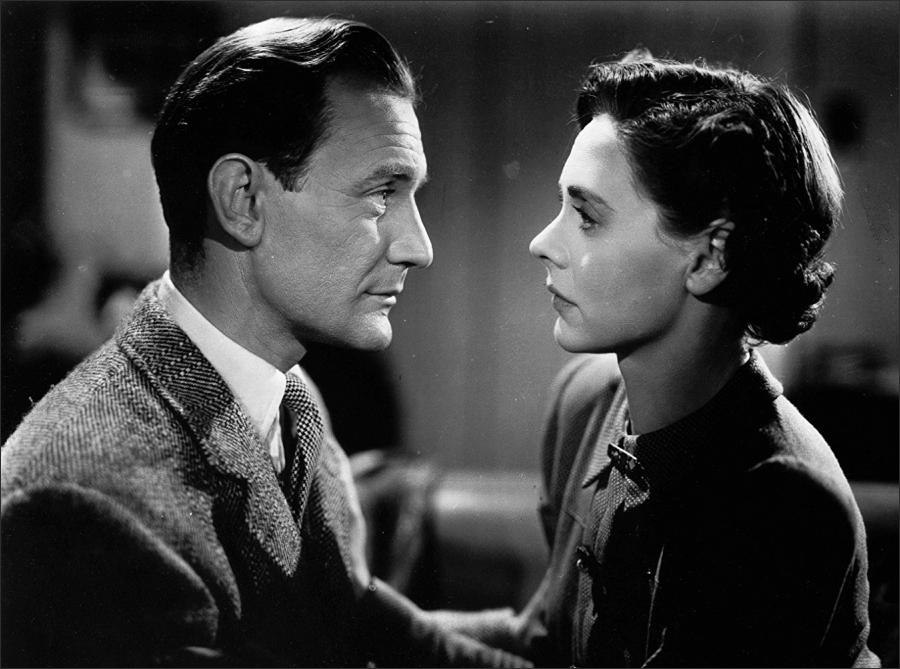
– Dr. Alec Harvey: Forgive me?
– Laura Jesson: Forgive you for what?
– Dr. Alec Harvey: For everything. For meeting you, in the first place. For taking the piece of grit out of your eye. For loving you. For bringing you so much misery.
– Laura Jesson: I’ll forgive you if you’ll forgive me.
 Love is complicated—always has been—and people have spent entire civilizations trying to understand it. The nature of love remains endlessly intricate, for we are creatures governed by contradictions, and this emotion exerts a vast influence over our fleeting passage through the world. Across centuries, from classical epics to modern narratives, poets, playwrights, novelists, musicians, and philosophers have pursued the elusive architecture of affection. Yet no work has struck me with such visceral clarity in its conception of modern love as David Lean’s heartbreakingly lucid 1945 film. In many ways, this piercingly sincere piece of cinema offers one of the most compelling portrayals of two restless individuals recovering a sense of purpose through the spontaneous bond that arises between them, binding their lives to an unexpected destiny. For that reason, the film transcends the familiar parameters of a sorrowful romance. As a narrative of unrealized desire and the social pressures rooted in marital convention, its sadness surpasses melodramatic formula and shifts its inquiry into something closer to reflective essay than dramatic fiction. Thus, Brief Encounter articulates a philosophy of love that feels quietly radical, exposing the contradictions of the marital institution while delivering a precise moral critique of the British middle class of the 1940s.
Laura Jesson (Celia Johnson), the gentle and self-effacing woman at the center of the film, embodies the ordinary British middle-class life: she is married, has two children, and occupies a comfortable home defined by order and propriety. Her days move along familiar tracks—errands, caring for her family, and the weekly ritual of tea while she awaits the train. Alec Harvey (Trevor Howard), courteous and soft-spoken, mirrors her social world: a middle-class physician, a committed idealist, also with a wife and children. His schedule, however, drifts without the fixed rhythms of Laura’s, except for one constant—the discreet Thursday meetings he shares with her. Their first encounter at the station is accidental, but chance soon becomes pattern, and pattern becomes destiny, until both find themselves overtaken by a love they never anticipated. The affair seems unavoidable; from their initial spark, the film treats their bond as something that emerges despite every sensible barrier. Both are in their forties, both tied to marriages, and within their cultural moment the relationship is clearly untenable. Yet they surrender to the pull of possibility, embracing a romance tinged with adolescent fantasy. Derived from the 1936 one-act play Still Life, the film retains an economy of storytelling, allowing their liaison to unfold quickly—and to fade just as abruptly—while its emotional aftershocks endure. Laura recounts the episode from her living-room sofa, wrestling with whether to reveal her secret to her husband. The question that torments her, and that the film places before us, defines its philosophical stakes: Should they have consummated their love and chosen personal happiness over duty?
The simple contemplation of such a morally fraught situation is already unnerving. Any choice Laura and Alec reach will inevitably be filtered through the strictures that marriage, as an institution, has imposed upon Western culture. Is the film suggesting that the pledge—sacred or secular—between two individuals ultimately contradicts the very essence of love? If one speculates, the answer leans toward yes. Imagine Laura and Alec deciding to remain together, thereby rupturing the framework and stability of their respective households. Yet it seems mistaken to assume that love is willed rather than encountered, which means a choice so momentous should not be cast as inherently immoral or self-centered. It is irrational to cling to the fantasy of lifelong fidelity while ignoring love’s volatility and its fundamentally subjective nature. Matrimony carries an entire metaphysics of values that are often unexamined, one of them being happiness. What purpose does a union serve if it ultimately devolves into suffering? Some might argue that divorce exists to resolve this dilemma, but the very presence of divorce validates the illogic of the marital contract.
David Lean’s perceptive and clear-sighted filmmaking seems fully attuned to the subtleties woven throughout the narrative. The film’s emotional power — crystallized in the disciplined yet astonishing Dutch angles marking the dizzying train-station finale — expresses with aching sympathy the futility of a romance constrained by two principled individuals unwilling to betray their own ethical anxieties, and thus crushed beneath the weight of societal obedience. Brief Encounter devastates because, aside from our intimate identification with its lovers, it articulates the disorder of love in its most mature and uncontaminated manifestation. To watch two people fall in love in its purest register, devoid of erotic deviation or bodily frivolity, guided only by the nobility of feeling, is among the most rewarding cinematic experiences; you think, tremble, and mourn in harmony with Laura and Alec’s emotional dilemmas. The sharp final chord functions as a plea for a reconsideration of Western moral tradition.
In conclusion, this mournful chronicle of forbidden love invites interpretation from a wide array of interdisciplinary angles. The narrative presses for an almost civic engagement from its audience, urging us to examine the contentious issues it raises through multiple critical lenses. Watching Alec and Laura’s happiness implode under the weight of guilt, we instinctively sense that something is fundamentally awry in the social institutions that presume to govern our feelings and dictate our moral bearings. This is, at its core, a philosophical rather than bureaucratic concern, and it is within that realm that love should be preserved — as a universal idiom free of rigid prescriptions. Brief Encounter is thus emotionally accessible; the conversational texture that shapes nearly the entire film carries a universal cadence. Cinema harnesses this language, adapting it into its own expressive vocabulary to craft something so innately human that it can pierce even the coldest defenses. The philosophy of love may be endlessly intricate, but approaching it through the poetic clarity of Brief Encounter is as illuminating a beginning as one could hope for — perhaps even a path toward genuine understanding.