Directed by Michael Mohan
Written by Andrew Lobel
Starring:
- Sydney Sweeney as Sister Cecilia
- Álvaro Morte as Father Sal Tedeschi
- Simona Tabasco as Sister Mary
- Benedetta Porcaroli as Sister Gwen
- Dora Romano as Mother Superior
- Giorgio Colangeli as Cardinal Franco Merola
Rating: 
Sometimes, when a film’s thematic fabric is woven so tightly with familiar references, it raises the question: what remains when the scaffolding of influence is stripped away? Perhaps very little—but that absence might at least provoke filmmakers to articulate something original in cinematic terms. In the case of Michael Mohan’s Immaculate, the over-reliance on Rosemary’s Baby-style psychological horror and the familiar trappings of nunsploitation renders its ambitions disappointingly transparent. Still, as far as derivations of Polanski’s film go, Immaculate is a striking entry—visually lush and rich in exploitation flourishes. Its staggering perversity may not always deliver intellectually, but its suggestive undercurrents are, in their own way, compellingly executed.
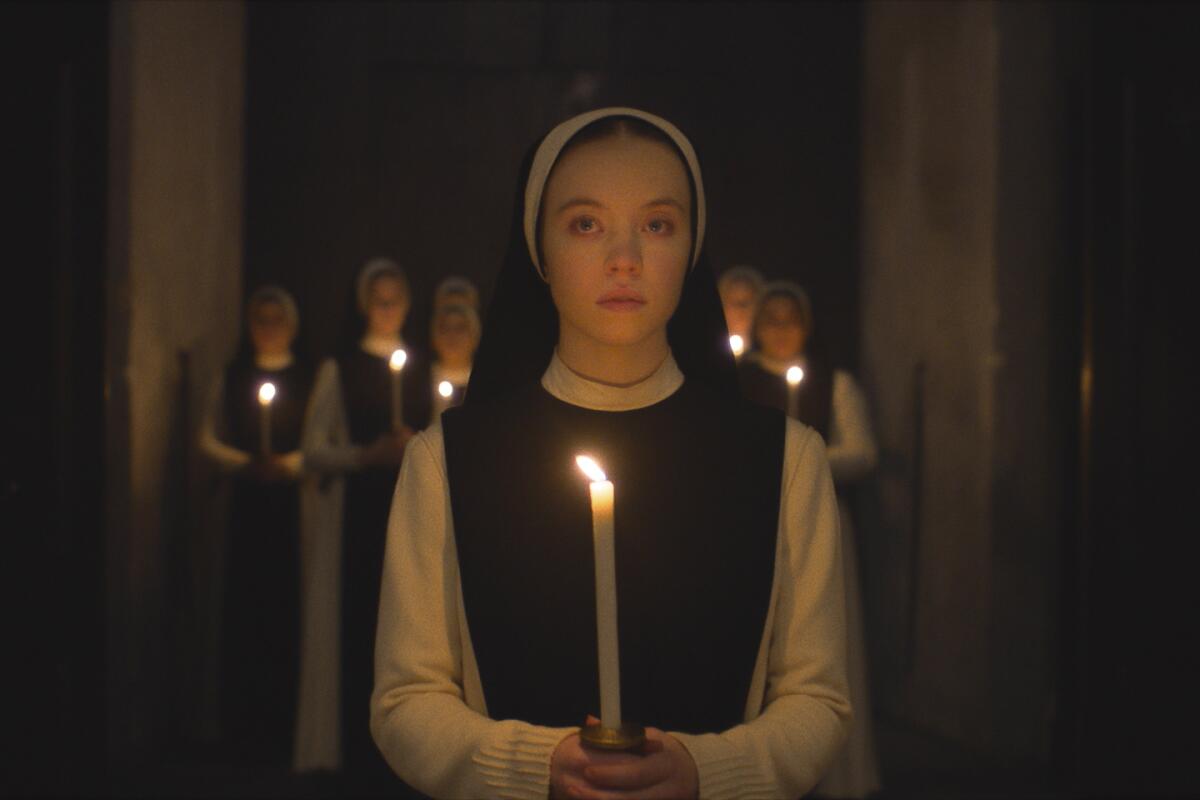
On paper, it’s nothing new: young American nun Sister Cecilia (Sydney Sweeney) moves into a picturesque convent in Italy, a sort of religious retirement home for old nuns. But the vibes are off. The convent is big and beautiful in that “sponsored by the Vatican’s art department” way, but the priests running the place are straight-up patriarchal weirdos—ceremonial, stiff, and vaguely menacing. Michael Mohan keeps the surface respectable—no devil orgies, no exorcism vomit—yet the icon-smashing still happens. It’s just filtered through the sultry, almost voyeuristic cinematography of Elisha Christian, who turns every corridor into a runway of ritualized repression. Everything’s lit like an erotic vision, and before long, you realize you’re not watching a story of faith—you’re watching a descent into holy psychosis. A slow burn into visual madness, where the gospel gives way to gory dogma, and piety melts into derangement. A classed-up neo-nunsploitation flick that pretends it’s not one—and almost gets away with it.
Mohan doesn’t do slow-burn dread. There’s no real situational horror here, no creeping paranoia. But when the blood hits the floor and the fake piety peels off, that’s when his direction wakes up. When Immaculate drops the supernatural fluff and goes full shock-mode, the camera swells—it gets operatic. That’s where Mohan shines: in staging outrage without losing the plot’s core ideas. With its brisk runtime and stripped-down structure, the film isn’t here to sermonize. And frankly, I’ve had it with critics projecting metaphysical nuance onto what is, at heart, a brutally stylized gut-punch. Forget the thinkpieces—this is a savage little beast about religious madness, not some meandering parable about bodily autonomy. Sure, that theme exists in the margins, but if you think that’s the centerpiece, you’re watching a different movie. What does carry the film, beyond the gore and gorgeous heresy? Sydney Sweeney, who tears through the role like she’s on fire.
Immaculate wrings every ounce of dread from its sanctified backdrop, turning the sweeping convent halls into a velvet-lined purgatory. The biblical verse it borrows—“Satan himself masquerades as an angel of light”—isn’t just window dressing; it’s the whole damn skeleton of the story. And man, does it bleed. But what really makes it sing is Sydney Sweeney, delivering one of the most ferocious performances horror’s had in years. Her descent into madness isn’t just compelling—it’s terrifying, because she never breaks. She holds the camera’s gaze through every shriek, sob, and twitch, her face locked in this grotesque, ecstatic tension. It’s rare to see a film let an actress burn that brightly without flinching. This isn’t just a bloodbath—it’s a showcase. And she owns every frame of it.