Directed by Matt Bettinelli-Olpin and Tyler Gillett
Written by Stephen Shields and Guy Busick
Starring:
- Alisha Weir as Abigail
- Melissa Barrera as Joey
- Dan Stevens as Frank
- Kathryn Newton as Sammy
- Will Catlett as Rickles
Rating: 
I must confess that I’m tiring of the same illusion crumbling again and again: the fatuous belief that tampering with cinematic modes or reshaping a film’s genre might spare it from the threadbare clichés that haunt horror. And even more absurd is the belief that sidestepping tropes alone can conjure a true reimagining of its mythic structure.
There is nothing remotely fresh in Matt Bettinelli-Olpin and Tyler Gillett’s self-consciously over-designed Abigail; modernization is not synonymous with improvement, and novelty is never cosmetic. It must be one or the other—there is no liminal space between. If you insist on reframing a mythic horror entity from a standpoint that betrays its nature, then forge a new path. But don’t peddle a tired framework under a new mask, counting on your audience to mistake aesthetic tinkering for true transformation.
Abigail begins as a crime thriller in which six unremarkable criminals abduct a young ballet dancer, hoping to score a sizable ransom. Then, abruptly, it morphs into a vampire film staged like an awkward comedy sketch. Spoiler alert? Hardly. By then, the movie has already spelled out its plot in capital letters—starting with the not-so-subtle choice of naming the vampire in the title. And yet, under the direction of Matt Bettinelli-Olpin and Tyler Gillett, the entire first act unfolds as though a major revelation is looming. It’s as if you walked into Tod Browning’s Dracula and the film tried to make you question whether Lugosi is, in fact, the undead Count. Absurd, right? Of course we know from frame one that he’s Dracula. Just like no one ever watched The Lost Boys wondering whether Kiefer Sutherland is anything but a vampire in leather.
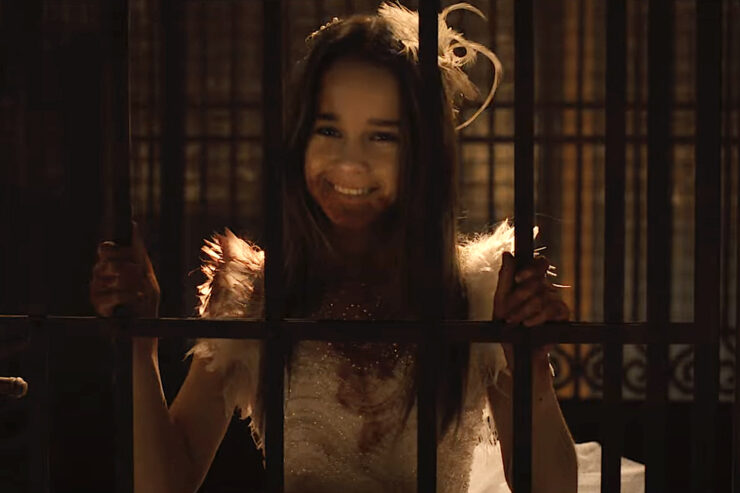
Abigail tries to hide its messy genre identity with some lazy tricks straight from the playbook. First, it pretends to be a blood-soaked Reservoir Dogs, then flips into a vampire-in-the-house setup—complete with locked doors, panicked crooks, and a bloodsucker on the prowl. The second angle works better, but the movie still bounces between cartoonish nonsense and half-serious gore. It never finds a tone—comedy and horror just cancel each other out. What’s left is a confused mess I haven’t felt since Blade decided leather jackets and martial arts could pass for vampire lore. Genre-wise, it’s all over the place—every time it tries to give the characters depth, it hits reset and dives headfirst into bloodbath mode. Melissa Barrera, Dan Stevens, Will Catlett, Angus Cloud, Kathryn Newton, and Kevin Durand play the six would-be criminals. On paper, they’re opposites. On screen, they’re just stereotypes waiting to die. They start as the threats, but end up hunted by the girl they snatched—Abigail, played by a feral Alisha Weir.
Amid the film’s chaotic tonal shifts, the performances perform their function—playful, foolish, and competent enough to carry the story forward. But beyond a few seconds of half-hearted sentimentality, there is nothing approaching an emotionally resonant moment that might justify the vampire carnage as anything more than empty spectacle. By “redeemable emotions,” I mean the basic narrative pulse of fear, or the desire to live—feelings that these characters, supposedly shaped by murky backstories, should theoretically possess. But such dimensions are sacrificed in favor of excessive gore and juvenile violence—too adolescent in tone to be remotely engaging. The experience is draining. Dan Stevens alone manages to deliver a performance with weight; the rest are left adrift. And as for Bettinelli-Olpin and Gillett, their overindulgent style takes up far too much oxygen. Bloated, indulgent, and far too enamored with itself. They were more at home in the self-aware satire of Scream.