-Shock Theater Special digs into the darker corners of vintage cinema, where Poverty Row horrors, cheap B-movies, mad scientists, giant creatures, haunted houses, and rubber-suited monsters ruled the screen. Forgotten shockers, bizarre oddities, and classic creature features—all the low-budget thrills that made the drive-ins and grindhouses roar-
Directed by Stuart Heisler
Written by Stuart Anthony
Starring:
- Ellen Drew as Susan Webster
- Phillip Terry as Scot Webster
- Robert Paige as Larry Reed
- Paul Lukas as W. S. Bruhl
- Joseph Calleia as Deacon
- Onslow Stevens as J. Stanley McMasters
- George Zucco as Dr. Parry
Rating: 
[WARNING: I’m about use gorilla and ape interchangeably in this article. If you want to call me an uneducated swine for this editorial decision–I just want you to know that you’re correct so you can rest easy now.]
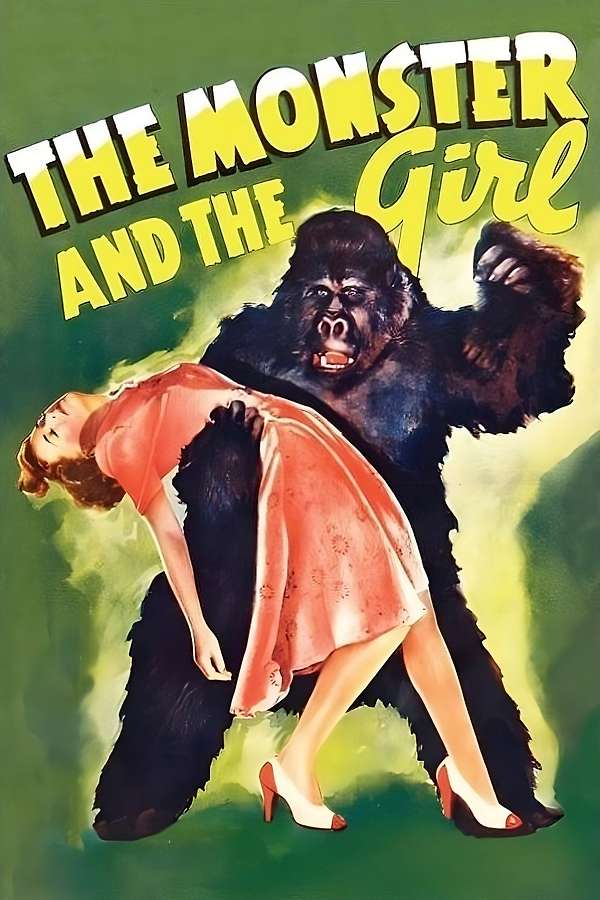 Ah yes, the killer ape movie. Long a staple of the many cheap horror flicks made during the decades leading up to the middle of the 20th century. A subgenre that I feel was a product of pure capitalism. I can just imagine a cigar chomping producer saying something along the lines of, “I know we have monkey suit around here somewhere. I mean it looks enough like monster to me… and I know Bela works for cheap!”
If that’s not the exact thought process, it’s somewhere in that ballpark because these movies are pure golden age, bottom bill programmer slop. So, when I see a movie titled “The Monster and the Girl” featuring a gorilla holding a girl on the poster art, I will kindly present my tray to dish up another amorphous pile of cinematic gruel for an enjoyable hour of empty calorie entertainment.
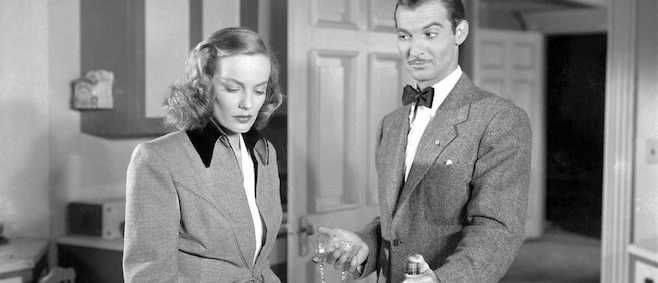
Well, color me surprised when I pop in the blu ray and am met with a… gangster noir courtroom drama? But hey, it’s pretty well shot at least. Makes sense as this is a Paramount picture, not a Monogram or PRC production. So it’s definitely a sleeker production compared to the kinds of studios you’d expect to make a film of this kind. Though we’re not too far away from Poverty Row as we have the king of the PRC horror film, George Zucco, sitting quietly in the courtroom as each side makes their case on the fate of a man accused of murder.
The prosecution presents a pretty open and shut case, he was on the scene holding the murder weapon; seen by several witnesses to boot. The defendant argues that the man shot dead was the work of an assassin lurking in the corner, only to toss the gun over to the accused after the deed is done to frame him.
Then the accused’s sister takes the stand, revealing that her brother was looking for the man she married after escaping to the big city from her humdrum country existence. Only the man she claimed to marry doesn’t exist!
He married her under false pretense, only to pawn her off to his mafioso cronies who extort her into prostitution on the morning following their rambunctious and expensive night consummating their sham marriage.
Geez. Must say that’s a pretty edgy plotline for a movie made during the peak of Hayes Code censorship.
Wait… isn’t this supposed to be a killer ape movie?
Long story short, the jury doesn’t buy it, and he’s condemned to get the full force of the prison’s electrical grid jolted through his body. But not before he agrees to donate his brain to George Zucco, who pitches a grandiose hypothesis for an experiment that he believes will forever fix the follies that mankind has so struggled with throughout the ages.
His plan?
Transplant a human brain into the body of a gorilla for some fucking reason. Yep, we’re now firmly in full poverty row madness territory!
You’re probably asking, did this experiment fix the problems of man’s nature that cause so much ill in the world?
Of course not. How could it?
It does, however, give our vengeance filled protagonist the agility and strength of a damn gorilla! I guess it’s time to pulverize some dickheads…
…And that he does until the end of the movie.
Goodnight!
Wait.
Now, what you may have pictured in your head while reading that synopsis is a film that is nothing more than another campy poverty row monster romp. If so, you’re pretty much right… mostly.
The thing with this movie is that it truly is a campy, messy, and downright ridiculous B-movie. That was kind of a given going into it. Yet, despite all of that working against it, the final result is something that has absolutely ZERO business being as good as it is.
Let me explain…
Trust me.
Okay?
The narrative is honestly very jarring, starting out with a totally grounded noir story that takes up the first half of the runtime. No horror elements whatsoever, at least the fantastical ones. Then it takes a hard left turn into a mad scientist/killer ape/monster on the loose movie. This is when the movie really starts to cook.
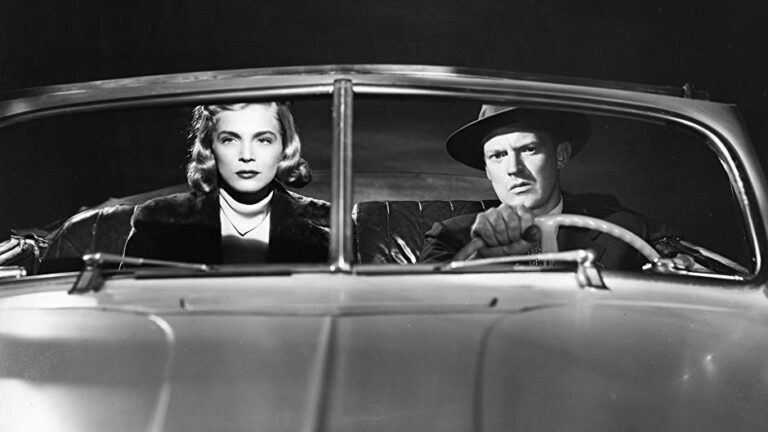
The most obvious thing is lighting and the cinematography. Since it is a studio film, it’s expected that it’s going to look competent. But it’s really good here. Excellent use of shadow, effective use of noir lighting tropes (like the flickering neon sign), and those rain-soaked city streets. You can definitely tell that they’re squeezing what they can from a limited number of sets on the studio backlot, but every drop is extracted with a deft hand.
Then, there is the key element that puts this movie above the rest in its weight class; that is Charles Gemora’s gorilla suit performance.
In these kinds of movies, the gorilla suit is generally pretty silly looking with limited or nonexistent facial modality and droopy ass arms. This movie is a totally different story.
The suit is incredible. So good that I had a moment where I questioned if I was watching a real gorilla on screen (of course not, dumbass). Complimentary to that is Gemora’s movements. I read that he intently studied gorillas for the purposes of delivering more authentic suit performances and it shows.
But what really caps it off is the way he acts with his eyes. Since he can’t talk, he conveys the whole inner journey of the gorilla man through his eyes alone. You can see it. He really sells that there is still a human in there.
This alone added what I’d argue is a compelling dramatic layer to a movie where any expectation of such a thing was already out the window before it even started. I’d even go so far as to say that this might be the greatest gorilla suit performance pre-1968. I’m sure there probably is a better one, but from what I’ve seen up until this point, Gemora in The Monster and the Girl remains my number 1 pick. Plus, Gemora did say that this was his favorite film he worked on.
Oh, and who can forget Skippy the dog? Yes, there’s a fucking dog character in this movie who features heavily in the second half.
Skippy was owned by the gorilla man, pre-operation and ends up recognizing him despite him being nearly a whole other species. Skippy ends up following him around town as he hops over city rooftops to stalk his prey. Usually, an aspect like this would also be a strike against the movie as it stands on the precipice of being too shmaltzy. And in any other case this whole sub-plot is. But Skippy is soooo good. And I dare say that the relationship between the two is equally touching and heartbreaking.
Judge me all you want but I got a lump in my throat over it.
I don’t know what to tell ya.
Another note I’d like to highlight is the use of music. There isn’t a lot, with most of the soundtrack being diegetic throughout. I’ve seen this criticized by some, but to me, I think it’s kind of ahead of its time.
Suspense scenes are quiet. No mounting tension cues or the ear-piercing explosion of orchestral brass and drums when the monster finally attacks. The case where there is music in one of these suspenseful moments, it’s just coming from a radio.
I like this aspect a lot. I think it lets go of the viewer’s hand, allowing them to sit in the moment. It feels ahead of its time in my opinion. It almost feels like a build up to the truly game changing suspense techniques used in the Val Lewton pictures that started being made only a year later.
Maybe I’m too enthusiastic but this aspect really struck me during my most recent viewing. And I do think this was intentional, because cues are still used but it feels deliberate. They’re subtle, with some even being expertly fused in with the natural soundscape of a scene.
All this being said, this is spiritually a derivative, pulpy poverty row chiller. I can poke holes in the logic of the script all day.
The whole gorilla brain transplant subplot never really justifies itself. The entire revenge plot is pretty potboiler stuff, and it is wholly derivative of The Walking Dead (1936), but swapping out zombie Karloff with a Franken-gorilla.
I’ll even say that the George Zucco action is kind of disappointing. He’s not delightfully unhinged like he is in his PRC roles. He mostly spends his screentime just quietly showing up in the background to peep the murder scenes. Zucco’s character feels more like a plot device than an actual character that has any stake in the action. He’s merely there to poorly justify a plot point by spewing his incoherent theories about putting a man’s brain into a gorilla to erase humanity’s negative passions or some shit. He does have a great spooky castle and laboratory, though. But even those sets are sadly underutilized.
But as I’ve laid out throughout my review, this movie just manages to make the absolute best version of what it is. And for it being barely over an hour, it manages to pack a lot into its short runtime.
This is why I’m so passionate about this silly little picture. I love going into a movie in which my expectations are so unbelievably low, yet it manages to surprise the hell out of me. It’s truly my favorite kind of movie.