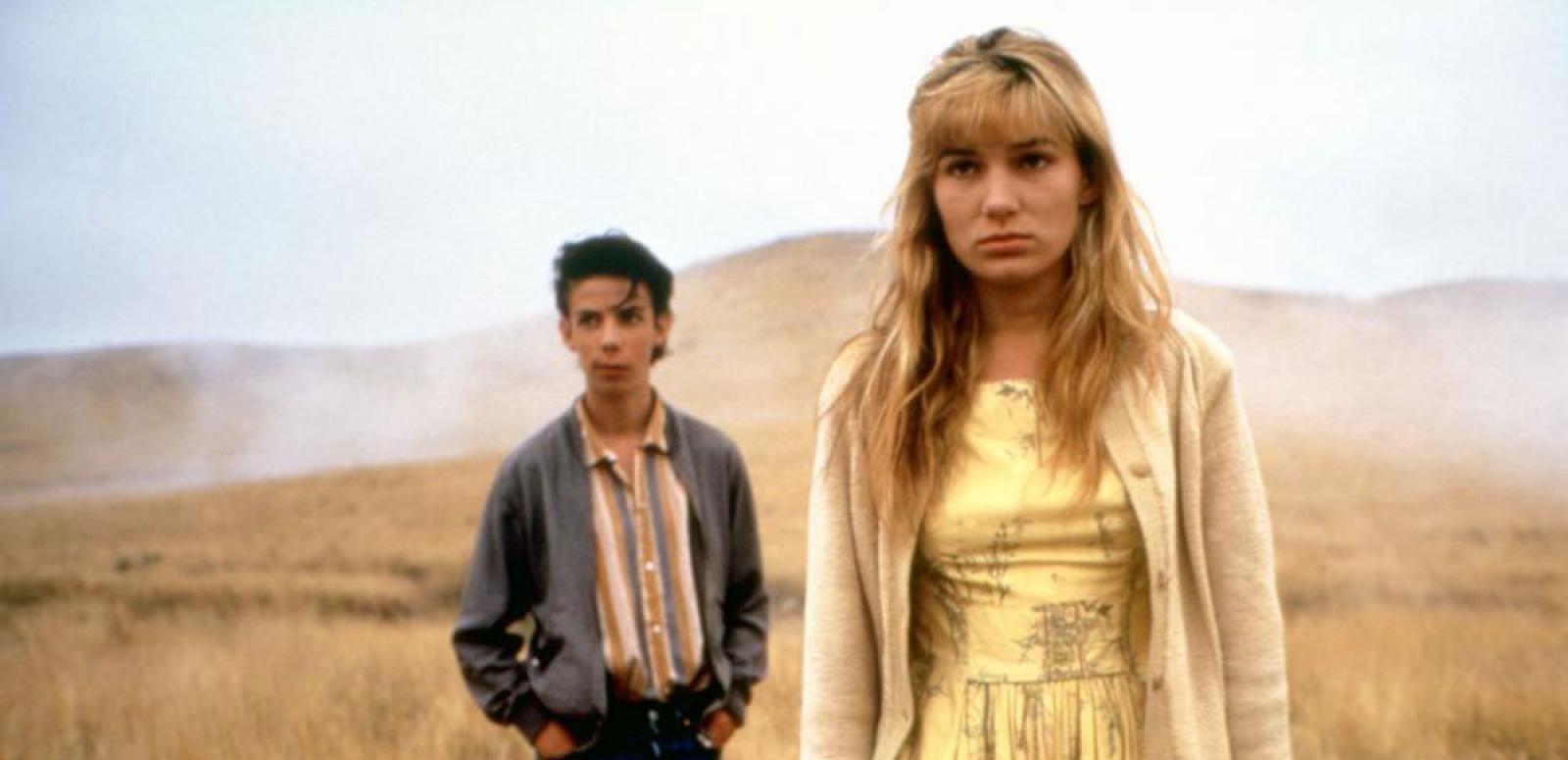
Directed by John Duigan
Written by John Duigan
Starring:
- Noah Taylor as Danny Embling
- Loene Carmen as Freya Olson
- Ben Mendelsohn as Trevor Leishman
- Graeme Blundell as Nils Olson
- Lynette Curran as Anne Olson
- Malcolm Robertson as Bruce Embling
- Judi Farr as Sheila Embling
Rating: 
This wistful Australian coming-of-age film unfolds with the natural rhythm of life itself, guided by the insightful, autobiographical vision of John Duigan, whose blend of directorial and literary sensibility turns his bittersweet adolescent memoir into pure poetry rather than mere narrative. Though this quasi-folkloric tragedy, steeped in the pastoral warmth and spellbinding rural quietude of a small Australian town, seems at first to share the familiar social preoccupations of The Last American Virgin and similar tales, it quickly reveals itself as something singular — Duigan’s own lyrical elegy to youth, among the most artful ever captured on celluloid.
The typical teenage brew of awkwardness and insecurity finds vivid embodiment in Noah Taylor’s Danny, a 15-year-old lacking social grace but gifted with quiet visual acuity. Danny is more seer than speaker, hopelessly enamored with his childhood friend Freya (Loene Carmen), a year older and infinitely more at ease in the world. She is lively, sociable, and flirtatious, yet their friendship is charged with a rare tenderness — an empathy so palpable it borders on love. But when Freya falls for the brash high-school rugby player Trevor (Ben Mendelsohn), Danny’s emotional world begins to fracture. What sets this luminous coming-of-age story apart from its countless peers is its grave, unhurried attention to the tremors of adolescence. The omnipresent pastoral calm — rendered exquisitely by cinematographer Geoff Burton — lends weight to the quiet sorrow that seeps through the characters’ lives, eventually touching the audience too.
It sings like a teenage rhapsody—drenched in the fever of first loves and lost innocence—and mourns like a teenage elegy—exposing the frailty of youthful rebellion. Within it, Danny discovers that love is not possession but surrender, and that to fear giving oneself is to fear living. Its genius is to preach no moral at all, but to let the pulse of youth itself guide the story toward adulthood. Duigan brings a startling honesty to the screen—feelings rendered with such clarity, images with such naked immediacy, that the film seems to echo the viewer’s own half-forgotten youth. His notion of teenage romance is not wrapped in idealism but grounded in flesh and appetite. The camera turns away from the perfumed rituals of love, seeking instead the pulse beneath—the fevered touch, the clumsy urgency, the beauty of wanting without words.
The tragedy of The Year My Voice Broke is not merely what happens to Danny, but what he cannot bring himself to do. Life drifts past him like a dream he’s unable to wake from—he watches, absorbs, suffers in silence—while Freya’s heart slips further into Trevor’s orbit. Among his many quiet torments, none is more excruciating than witnessing, from the same room, the girl he adores in another man’s arms. Few films are so willing to dwell in such unbearable awkwardness. By the end, fate compels Danny to see beyond his wounded desire; tragedy reshapes his vision. He learns that time is pitiless—that no matter the depth of one’s feeling, life marches on, indifferent and unstoppable.
The beauty of this film is so overwhelming that even Duigan’s own poetry as a filmmaker seems entranced by it. In his hands, establishing shots cease to be mere markers of setting; they become instruments for revealing the inner moods of his characters through their surroundings. It’s a remarkable directorial approach—one I had never quite grasped until now. Each of these shots radiates visual purity. Their aesthetic power and poetic sensitivity lie somewhere between Malick’s sacred naturalism and Davies’s elegiac memoryscapes.
It works flawlessly as a memory piece. The final words Danny speaks—delivered with aching sincerity by Noah Taylor—resonate deeply as the cool winds and the calm of the place he once shared with his beloved surround him. They are as profound as they are difficult to accept. That’s life, I suppose. Both heartbreaking and breathtaking.