-Grindhouse Fest spotlights the cult gems, sleaze classics, and deranged wonders that defined exploitation cinema’s golden run. Proceed with delight and caution-
Directed by Aldo Lado
Written by Roberto Infascelli, Renato Izzo and Aldo Lado
Starring:
- Flavio Bucci as Blackie
- Macha Méril as The Lady on the Train
- Gianfranco De Grassi as Curly
- Enrico Maria Salerno as Prof. Giulio Stradi
- Marina Berti as Laura Stradi
- Irene Miracle as Margaret Hollenbach
- Laura D’Angelo as Lisa Stradi
Rating: 
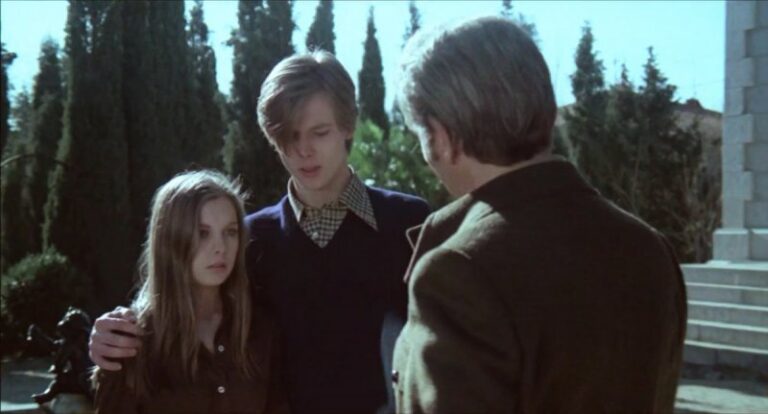
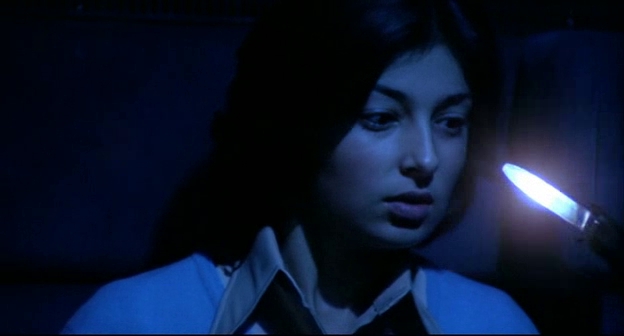
The European counterpoint to Wes Craven’s The Last House on the Left is less a shock fest than a bitter political howl—crueler in spirit, but ultimately a coarse distortion of Craven’s ferocious 1972 revenge parable. Aldo Lado—one of the essential craftsmen of Italian exploitation—at least attempts to move beyond mere imitation, constructing a vicious morality tale around two young travelers (Irene Miracle and Laura D’Angelo) journeying by train from Germany to Italy on Christmas Eve. Their chance encounter with two low-grade criminals (Flavio Bucci and Gianfranco De Grassi)—one a strung-out addict, both equally twisted—already signals disaster. Worse yet, they cross paths with a refined, impeccably dressed woman (Macha Méril) whose elegance masks a rotting sexual pathology. With these figures assembled, Lado has all he needs to turn a simple holiday commute into an infernal passage.
The film’s storyline—essentially Craven’s narrative re-staged on a moving train—unfolds through a series of contrivances, yet maintains an oddly discursive rhythm that owes more to satire than to traditional genre form. Consequently, it never fully embodies the typical revenge or rape-revenge template; instead, it operates as a bleak exploitation piece steeped in misanthropic commentary on post-war Europe. Through an unfeeling visual design, Lado drains the violence of sensationalism, treating the cruelty not as spectacle but as a grim reflection of the era’s moral desolation. And yet, these virtues double as flaws: the feral performances—Macha Méril’s wickedness is an icy response to David Hess’s savagery in Craven’s film—and the script’s clinical frigidity ultimately work at cross-purposes with the political gravity Lado seeks. One walks away with a sense of something unresolved; not a failure of climax, but a failure of the film to fuse its social thesis with its own fevered viciousness.