Directed by Eloy de la Iglesia
Written by Eloy de la Iglesia, Juan Antonio Porto and Antonio Corencia
Starring:
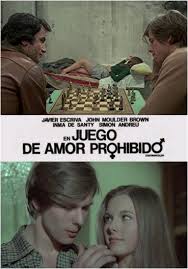
- Javier Escrivá as Don Luis
- John Moulder-Brown as Miguel
- Inma de Santis as Julia
- Simón Andreu as Jaime
- Joaquín Pamplona as Comisario de policía
- Blaki as Damián
- Paul Benson as Sir William
Release Date: September 22, 1975
Rating: 
 Usually, with a psychosexual setup this volatile, the story settles for a trio of characters forming a tidy triumvirate of lust, sensuality, and jealousy; but for a renegade director like Eloy de la Iglesia, that would be far too simple and trivial for his concerns—which lean more Marxist than populist—so he drags a fourth character into the arrangement, turning the expected threesome into a quartet of erotic possibilities, and inevitably political ones. In Francoist Spain, hardly anyone treated sex as politics the way the openly gay Marxist—the man Spanish fascism despised most—did; it was a tactic more common in exploitation films pitched to an arty audience rather than the straight schlock trade. Homoeroticism, drugs, and socialism started breaking through the barriers of Spain’s ultra-conservative film censorship in the early 1970s.
Forbidden Love Game marks the last moment when Eloy de la Iglesia relied on the delicate craft of suggestion to say whatever the fuck he wanted on screen. It premiered in 1975, only months before Spain’s aging dictator Francisco Franco finally died, taking his prehistoric ideology to the grave with him. Like Eloy’s savage Cannibal Man, the film suffered under the heavy scissors of censorship, with more than sixty cuts leaving several scenes brutally truncated. Still, that hardly matters; no matter how hard they tried to bury the film’s libertine sexuality, the debauchery seeps through with elegance and metaphorical bite in every minute of transgressive suggestion.
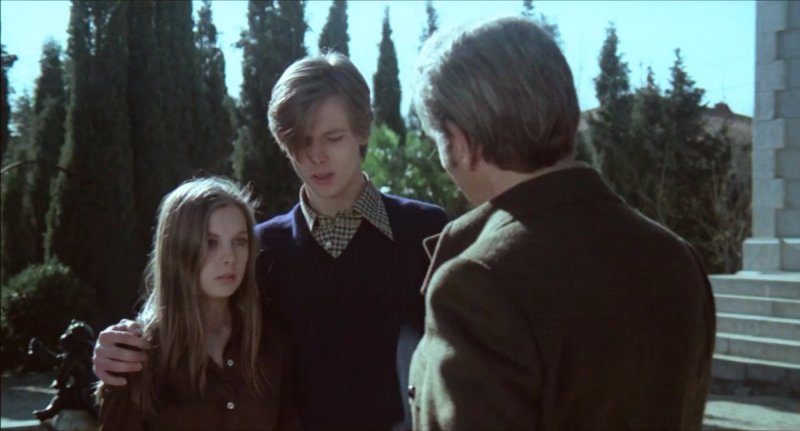
It’s the kind of salacious premise that Eloy de la Iglesia handles with a disarming sense of naturalism, yet without sacrificing the intentional provocation that always lingers within the satirical style of this sort of political commentary. It is Javier Escrivá, cast as a wealthy, sophisticated, and discreetly gay university professor, who initiates us into this forbidden game of love. With Simon Andreu cast as one of the professor’s former students—now sharing his large, secluded mansion—the relationship suggests far more than it ever openly displays; but with Eloy de la Iglesia directing the scene, that suggestion alone is enough to let the imagination wander deep into queer fantasy. The game grows even kinkier when a runaway couple, Julia and Miguel—played by Inma de Santis and John Moulder-Brown—enter the narrative. Having fled their homes, they quickly fall under the seductive manipulation of their professor, Don Luis, portrayed by Javier Escrivá.
This depraved academic turns out to be an unnervingly unpredictable figure. His intentions initially appear simple, but his actions and motivations are far more intricate. Once he holds the two young runaways inside the vast home he shares with Simón Andreu, the narrative shifts toward the dynamics of power. Hierarchies take shape, class distinctions become evident, and sexual politics gain new layers. Eloy de la Iglesia introduces a form of revolution into the equation. The balance of power shifts, but the underlying cycle remains just as perverse. The commentary in Forbidden Love Game proves both deeply subversive and quietly admonishing. Observing the sexual dynamics of this quartet, we gradually realize that the fetish at work is not carnal but political—an obsession with power and violence directed at the weakest. The film’s tragic twist—one of the bleakest in Eloy’s cinema—is that regardless of where subversion originates, the most persistent human fetish will always be domination over others. Pure political pessimism, Eloy-style. But don’t let the intellectual ferocity typical of Eloy de la Iglesia fool you into thinking Forbidden Love Game is all theory and no thrill; it remains just as gripping as any of the Spanish director’s transgressive classics. The film plays like a violent crossroads between the thriller machinery of No One Heard the Scream and the erotic intrigue of El Diputado. Which is another way of saying that this stands among the sexiest works in his filmography.
And like any truly incendiary movie loaded with provocation—and sharp sociopolitical insight—it isn’t shy about controversial moments that only intensify the already blazing sexual mythology at its core. A 34-year-old Simón Andreu shares more than one erotic situation with a 16-year-old Inma de Santis. And nearly every gesture the teacher directs toward these young people carries the unmistakable scent of predation. Yet something curious unfolds inside this climate of forbidden desire: Eloy de la Iglesia turns the whole arrangement into a tragic gesture that, to my eyes, feels deeply moving—even oddly personal. Moving through these dark passions, the viewer stops being a critic and becomes a compassionate witness. Dictatorship in any form is a corruption of human nature itself, and arriving at that realization through the sexual labyrinth of human relationships is as disturbing as it is seductive. In that sense, exposing reality becomes less an act of condemnation than one of empathy—one of Eloy’s greatest achievements.