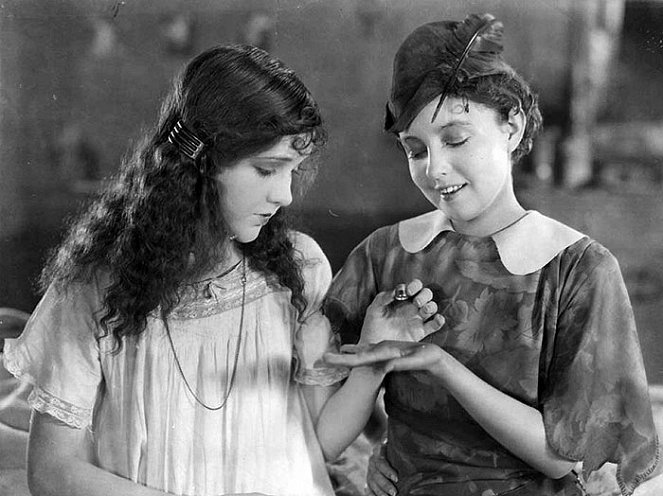
Directed by Herbert Brenon
Written by Willis Goldbeck
Starring:
- Betty Bronson as Peter Pan
- Mary Brian as Wendy Darling
- Ernest Torrence as Captain James Hook
- Virginia Browne Faire as Tinker Bell
- Esther Ralston as Mrs. Darling
- Cyril Chadwick as Mr. Darling
- George Ali as Nana the Dog
Rating: 
Like its eternal child-hero, Herbert Brenon’s Peter Pan is light, jubilant, and alive with magic. Produced by Famous Players-Lasky and carried to audiences by Paramount, it remains both the truest rendering of Barrie’s timeless play and a crown jewel of silent-era fantasy. Out of all the incarnations, whether animated or live-action, this one will always be my favorite—for me, the only version that breathes the essence of cinema itself. My devotion is therefore self-evident. Yet what makes it linger most is not only its fidelity or its striking visual design, but its singular sweetness, its openhearted sincerity, which no other adaptation has matched.
In crafting the screenplay, Willis Goldbeck wisely retains the moral essence of Barrie’s tale, allowing Herbert Brenon to shape it with an organic maturity, steering always toward that luminous balance of sorrow and delight. Thus, the story surges forward with the exuberance of a child tasting life for the first time, while its enchanting pageantry, alive with the ideals of childhood adventure, never relinquishes the adult sensibility nor the moral clarity embedded in Barrie’s vision—a discernment that glimmers through even the lightest gaiety of the film’s atmosphere.
Watching Peter Pan as a silent film is like being reminded what cinema was born for. The silence strips everything bare. And this is crucial, because the story isn’t some harmless children’s diversion—it’s a myth tangled in existential terror. I’ve always felt it’s one of the rare stories that drops cosmic moral dilemmas into a child’s lap: death, eternity, responsibility, desire. Spoken dialogue would only dull the knife. Silent film lets the blade sink in. It speaks with the raw candor of the human face, which is more eloquent than any line of dialogue ever written: joy, fear, cruelty, ecstasy—expressed without words, impossible to fake. And then there’s the mise en scène: not just backdrop, but an intimate, shifting metaphor, polymorphous and restless, embodying the inexpressible. Rooms and spaces suddenly feel alive, charged with metaphorical weight, becoming part of the drama of existence itself. That’s why the silent Peter Pan punches harder than any remake—it cuts cinema down to the bone, and in the marrow of that simplicity, it finds infinity.
This movie’s packed with moments that show why it nails Barrie’s play better than anything that came after, but if I’ve got to pick just one, it’s Betty Bronson. Forget everything else—she is Peter Pan. A woman playing the eternal boy? Hell yeah, and she kills it. She’s got that bratty grin, the cocky-but-charming attitude, curls that refuse to behave, and the restless bounce of a kid running on pure mischief. Watching her, you don’t think “actress in costume”—you just see Peter Pan made flesh.
What truly secures Betty Bronson’s place as the most memorable Peter Pan on film is not just her impish vitality, but the delicate paradox she embodies. Because the role is a male character played by a female performer, there is an unavoidable grace, a subtle effeminacy in her gestures. Yet instead of undermining the boyish persona, this adds another layer to it, as though Peter had been a child so long that time itself had fused both masculine and feminine traits within him. In Bronson’s interpretation, Peter is not bound to one gendered ideal; he becomes a universal child, simultaneously playful and defiant, tender and cocky. The result is a hybrid presence, an androgynous embodiment of Barrie’s vision that subverts the purely male tradition of Peter Pan, this Peter Pan speaks to everyone, allowing both boys and girls to find themselves reflected in the eternal dreamer who never grows up.
Herbert Brenon ensures that his film contains nearly all the iconic moments audiences expect from Barrie’s tale: the ethereal mermaids, the sweeping, otherworldly vistas of Neverland, Peter’s unruly shadow that refuses to obey, the exhilarating swordplay between Hook’s pirates and the Lost Boys, and even Tiger Lily, here brought to life with youthful grace by a radiant Anna May Wong. Yet, for all the pageantry, Brenon’s emphasis—reinforced by James Wong Howe’s exquisite deep-focus imagery—rests less on the fantastical spectacle than on the pathos beneath it. His Peter Pan is not merely a figure of whimsy but one tinged with melancholy, a child-hero shadowed by tragedy, yearning even as he delights. This Peter Pan isn’t just fun and games—he’s tragic, wistful, a kid who’s forever stuck in a dream he can’t wake from.
Yes, Peter cackles, springs about, bestows kisses without knowing what they mean, and soars through Neverland as if the sky itself were play. But Brenon’s camera lingers in the quiet—there we see the lonely Peter, nostalgic and estranged, haunted by the very eternity he embodies. This is the one film that dares to peel back the myth, to show Peter not only as the child who will not grow up, but as the child who cannot. Betty Bronson captures that contradiction perfectly, turning conceit and immaturity into something aching, almost elegiac. In contrast stands Mary Brian’s Wendy, gentle, maternal, yet also a young woman with her own desires. She yearns for Peter romantically, while he, blinkered in his childishness, sees only the mother he never had.
What gives Brenon’s Peter Pan its lasting force isn’t just the spectacle. The sword-fighting between Peter and Hook, choreographed with a balletic thrill, is pure excitement. Ernest Torrence makes for a magnetic Hook, and George Ali’s astonishing turn in the suits of both Nana and the crocodile is a masterclass in physical performance. Nobody moves like that croc and dog combo. These delights root the story firmly in its playful, theatrical origins. But the film’s deepest sorrow unfurls beyond the trappings of spectacle. It actually wrecks you emotionally if you let it. Brenon’s the only guy who figured out Peter Pan works best when it’s part bedtime fantasy, part grown-up tragedy. That balance reaches its purest, most devastating form in the silent moment of Peter watching Wendy’s mother at the piano, grief cascading through her music. Here fantasy collapses, and the story becomes not just about youth’s delight, but about the inescapable ache of its impermanence. That’s the knockout punch, the real proof this version doesn’t just entertain—it breaks your heart wide open.