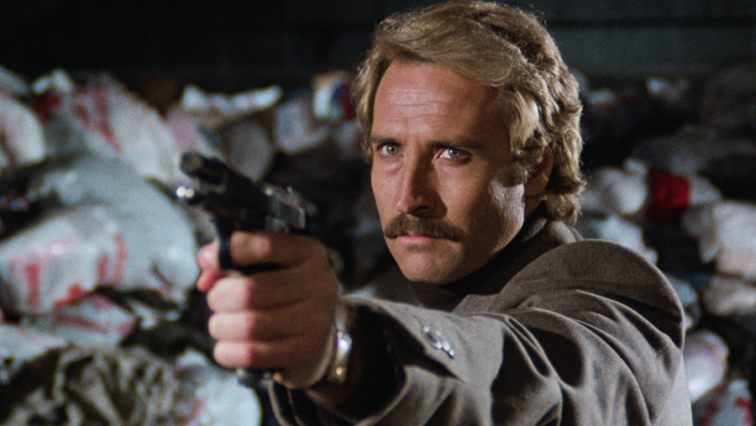
-Grindhouse Fest spotlights the cult gems, sleaze classics, and deranged wonders that defined exploitation cinema’s golden run. Proceed with delight and caution-
Directed by Umberto Lenzi
Written by Dardano Sacchetti
Starring:
- Maurizio Merli as Police Commissioner Leonardo Tanzi
- Arthur Kennedy as Vice Commissioner Ruini
- Giampiero Albertini as Police Inspector Francesco Caputo
- Ivan Rassimov as Tony Parenzo
- Biagio Pelligra as Savelli
- Tomas Milian as Vincenzo Moretto, also known as “Il Gobbo”
Rating: 
Umberto Lenzi’s violent poliziottesco sketches a tumultuous portrait of 1970s Rome, a metropolis drowning in crime and institutional decay. The film’s crude, vitriolic tenor allows its controversial director to display his sharpest qualities as a social cynic. In truth, one could claim that Lenzi’s entire body of work—whether trafficking in anthropophagy, the undead, or the labyrinthine logic of his gialli—operates as a socio-political critique. And really, is there a better battleground for an anti-bureaucratic blowout than a grimy, nerve-fraying cop thriller like this?
Maurizio Merli—basically Italy’s answer to Dirty Harry—steps in as Inspector Tanzi, the hot-headed boss of Rome’s anti-gang squad, hell-bent on taking down the crime kingpin who runs every racket in the city. The days of scattered street gangs are gone; crime has gone corporate, and one oversized mob outfit now controls the whole criminal food chain. Tanzi works by a simple rule: if he has to kill a crook to stop him, so be it. Naturally, his feral tactics clash with the spineless bureaucracy of Italy’s justice system. Judges cut loose every thug he collars, and the city’s streets stay rotten. But Tanzi’s refusal to bend keeps him storming ahead, using his volcanic brand of justice to dismantle the monolithic mob. Along the way, he meets every kind of sleaze Rome can cough up—a two-faced, sadistic hunchback played by Tomas Milian, and an especially vile drug pusher brought to life by Ivan Rassimov.
Lenzi’s glacially brutal direction hijacks the panic of the Years of Lead, steeping the whole plot in a toxic haze of paranoia, extremist posturing, revolutionary volatility, and state-sponsored dread. Everyone on screen pulls political weight. Tanzi embodies a sweaty brand of macho authoritarianism, while Milian’s deranged hunchback spews anarchic venom in every scene. Together they turn the film into a cracked manifesto of the violence that corroded Italy’s modern ambitions. Even wrapped in its sensational grindhouse skin, Lenzi’s poliziottesco edges toward a scuffed kind of social realism—not vérité, but an unvarnished stare into ’70s Italian turmoil, sharpened by its polemical bark. Yet Lenzi’s own ideology never quite surfaces, leaving you stumbling through a cloud of unresolved political static.
Tanzi is written as an out-and-out reactionary, and Merli’s fierce, stylish turn only amplifies it. His aggressive temper gets treated with kid gloves, and his hostility toward progressive reform never meets a real rebuttal. In contrast, the judicial system’s supposed humanitarian stance is torn apart with acidic fury. Lenzi seems hell-bent on mythologizing both ideological poles, staging a bitter smackdown between blind revolt and rigid order. But the film’s politics tilt. The hunchback—easily the most memorable antagonist in the story—wears an exaggerated leftist badge, even calling himself a proletarian with mocking pride. Tanzi might be a powder keg, but in Lenzi’s gaze he’s still the one who “makes sense.” These juxtapositions whip up a chaotic procession of problematic figures indulging in even more problematic behavior. And that strategic ambiguity Lenzi injects? It leaves me torn between admiration and utter confusion.
It’s undeniably morally dodgy filmmaking, the kind that invites the same righteous side-eye that Don Siegel’s Dirty Harry endured back in ’71. But whatever ideological charge you read into it, Lenzi still delivers a film loaded with jagged, unshakeable force. Fueled by Franco Micalizzi’s badass, pulse-jacking score and performances that turn every reprimand and bullet into myth, Lenzi’s poliziottesco stands as an uncomfortably relevant, thunderously bold slice of urban mayhem.