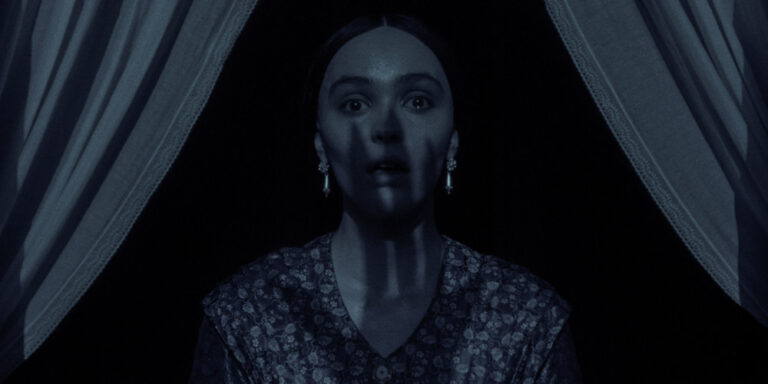
Directed by Manuela Martelli
Written by Manuela Martelli and Alejandra Moffat
Starring:
- Aline Küppenheim as Carmen
- Nicolás Sepúlveda as Elías
- Hugo Medina as Father Sánchez
- Alejandro Goic as Miguel
- Carmen Gloria Martínez as Estela
- Antonia Zegers as Raquel
Release Date: May 26, 2022
Rating: 
A rigorous lattice of abstruse semiotics structures this esoteric Chilean film, which operates as a politically incisive and aesthetically mature inquiry into human ethics under regimes of paranoia and uncertainty. Set in 1976, in the aftermath of the military overthrow of Salvador Allende’s socialist government by Augusto Pinochet, the narrative advances with studied passivity. Manuela Martelli’s debut feature distinguishes itself through restraint, rejecting ostentation and the habitual pretensions of first-time auteurs. The historiographical project of Chile ’76 unfolds within an intimate domestic frame, where historical violence is registered not through mass movement but through the psychological dislocation of an individual subject. Martelli’s embrace of symbolic density and refusal of narrative transparency yield a film composed of abstract visual patterns that articulate inner conflict—sometimes excessively opaque, but frequently crystallizing into a daring psychological portrait forged under authoritarian rule.
Carmen, portrayed by Aline Küppenheim with emblematic fortitude and an almost ascetic sense of moral restraint, is a bourgeois woman living in Santiago, married to a respected doctor and mother to two adult children whose lives still orbit the comforts of class stability. During the winter of 1976, she chooses to spend time at her summer house, a space still under renovation that mirrors her own provisional sense of security, where her days are quietly absorbed by domestic routines, childcare, and prolonged family meals. This carefully maintained normality is disrupted when the local priest, Father Sánchez (Hugo Medina), approaches her with a request that fractures the illusion of political distance: to provide medical assistance to an injured man he has hidden from the authorities. Carmen’s professional knowledge and ingrained humanism compel her to accept the task, even as she fully comprehends the dangers posed by disappearances, political persecution, and the omnipresent mechanisms of surveillance. She knows nothing of the man’s identity, nor of the circumstances that led to his injuries. As the implications of her decision gradually surface, Carmen’s quiet bravery proves insufficient, giving way to an anxiety that extends beyond fear for her family toward a deeper recognition of a country suspended in moral uncertainty, where silence becomes a protective reflex and ethical action is inseparable from complicity.
There is a quiet authority in Aline Küppenheim’s performance, her face etched with distress and estrangement, that commands the film as forcefully as Manuela Martelli’s austere visual compositions. From its opening moments, Chile ’76 signals that its unfolding tension will be articulated through restraint rather than spectacle, through suggestion rather than revelation. Martelli’s minimalist approach resembles a form of cinematic asceticism, at once serene and deeply unnerving, where meaning is excavated through silence and absence. The early sections of the film rely on off-camera space and the dense physicality of diegetic sound to construct a world that feels claustrophobically real, grounded in sensory immediacy. As Carmen’s inner life grows increasingly dominated by suspicion and dread, this physical realism is gradually stripped away, replaced by a metaphysical landscape that feels dreamlike, dislocated, and faintly hallucinatory. It becomes a film in which countless events seem to occur without ever fully materializing onscreen. The filmmakers’ greatest achievement lies in their refusal to overdetermine meaning, allowing the viewer to drift into the film’s psychological current. Like a psychedelic trance, the more one surrenders to its abstraction and detachment from the tangible world, the more profound the experience becomes. The enigmatic figures Carmen encounters during her clandestine movements appear only briefly, yet function as spectral reflections of her inner unease—phantoms of repression, guilt, and moral anxiety.
The film’s descent into nightmare advances in a quasi-Hitchcockian fashion, privileging sensuality and mood over explicit narrative markers. Martelli’s cinematography luxuriates in color and texture, while the ornate sound design subtly manipulates emotional registers. Red dominates the palette, functioning as a charged visual motif that merges erotic allure with imminent danger. The eroticism embedded in the film’s hypnotic mise-en-scène, and in the quiet romance of bourgeois comfort and idleness, may escape casual notice, yet it is precisely this sensorial pleasure that sharpens the film’s political critique. The narrative is deeply dependent on these visual patterns, which patiently cultivate symbolic resonance rather than overt meaning. Cryptic though it may appear, Martelli’s visual language is unmistakably purposeful: every frame, every chromatic variation, every measured movement contributes to a figurative meditation on the psychological residue of political violence. Such audacity in visual philosophy is rare, but when ambiguity is embraced as a mode of historical inquiry, the emotional and intellectual returns are immense. Carmen’s despair, unfolding within the serene illusion of bourgeois stability, becomes a haunting portrait of repression—beautiful, painful, and suffused with longing.
Chile ’76 appears determined to disappoint its audience, and that intention feels both calculated and uncompromising. From the outset, the film positions itself as the antithesis of an enlightening, didactic, or conventionally pleasurable cinematic experience. Drawing on the same deconstructive impulse that animated French New Wave cinema, Manuela Martelli undertakes a historical excavation rooted not in public spectacle but in the intimacy of memory. As a result, the narrative gravitates toward the textures of subjectivity rather than those of objective historical reconstruction. Act by act, the film advances through a rigorously controlled structure defined by potent anti-climaxes. Each time the viewer foolishly anticipates a shift toward the mechanics of an action-driven political thriller, the opposite occurs. The tension carefully cultivated through unpredictability is deliberately neutralized, drained of any cathartic release. There is no tangible menace that ever fully materializes onscreen; the anti-climax functions as an ethical safeguard, preserving the austerity of the film’s underlying argument. Ultimately, Chile ’76 resembles a meticulously constructed doctoral thesis in reflective filmmaking and cinematic semiotics more than a traditional narrative feature. And yet, whether encountered on the page or on the screen, the material remains deeply absorbing. In subverting the grammar of the contemporary thriller, the film gestures toward something extraordinary, leaving the unsettling impression of a work that hovers on the threshold of mastery.
Chile ’76 exists in a productive contradiction: it is a film that is simultaneously political and apolitical. Its critical apparatus resembles that of an overt political manifesto, yet within its tangible physicality there is nothing perspicuous, no explicit ideological declaration. Much like the diffuse workings of memory itself, everything appears blurred, fragmented, and elusive, allowing only sensations to be felt and evoked rather than clearly articulated. The humbly heroic feminism embedded within its moral dilemmas compels an interdisciplinary reading, inviting ethical, political, psychological, and phenomenological interpretations that help situate the film within a contemporary visual language of ambiguity. Unnervingly, the film seems to resist unveiling itself, as though its evasive silence and secrecy were allegorizing the pervasive apprehension of a society living under totalitarian scrutiny. There is an extraordinary density compressed into this restraint, a sense that so much exists within so little. Martelli’s radical use of spatial emptiness and temporal ambiguity offers no resolution, instead evading narrative closure through anti-narrative abstraction and potent anti-climactic voids reminiscent of Michelangelo Antonioni’s formal detachment. The result is a cinema that refuses to answer its own questions, burdening the viewer with the task of speculative interpretation across an infinite spectrum of meanings. This transcendent, intimate observation of the political—achieved without recourse to explicit rhetoric—constitutes an enigmatic and deeply authentic mode of expression, confirming Martelli as a visual storyteller of rare audacity and precision.